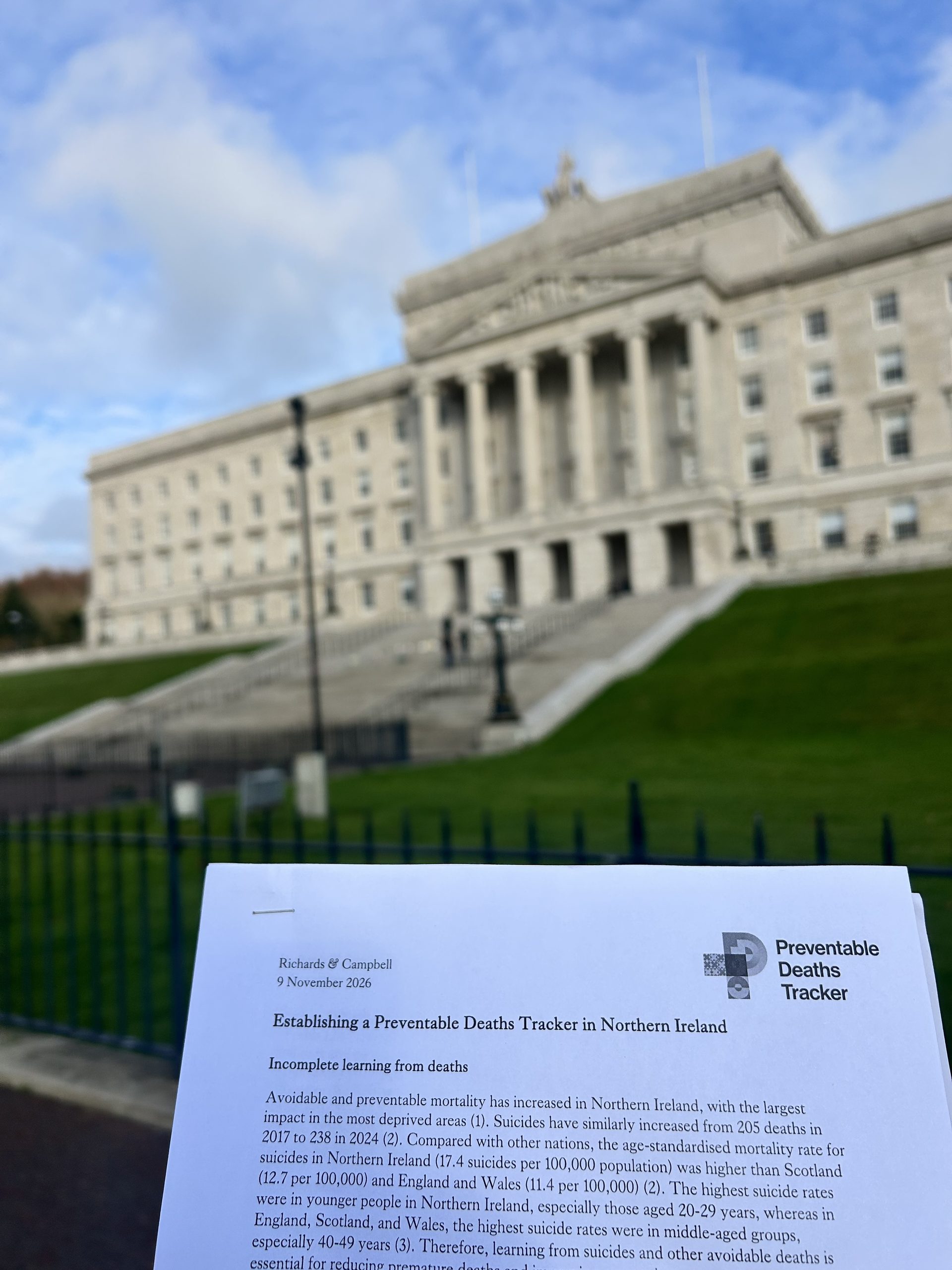
PRESS RELEASE: A wake-up call at Stormont
Researchers and suicide prevention advocates join forces at Stormont to call for a Preventable Deaths Tracker in Northern Ireland, turning lessons from tragedy into action.
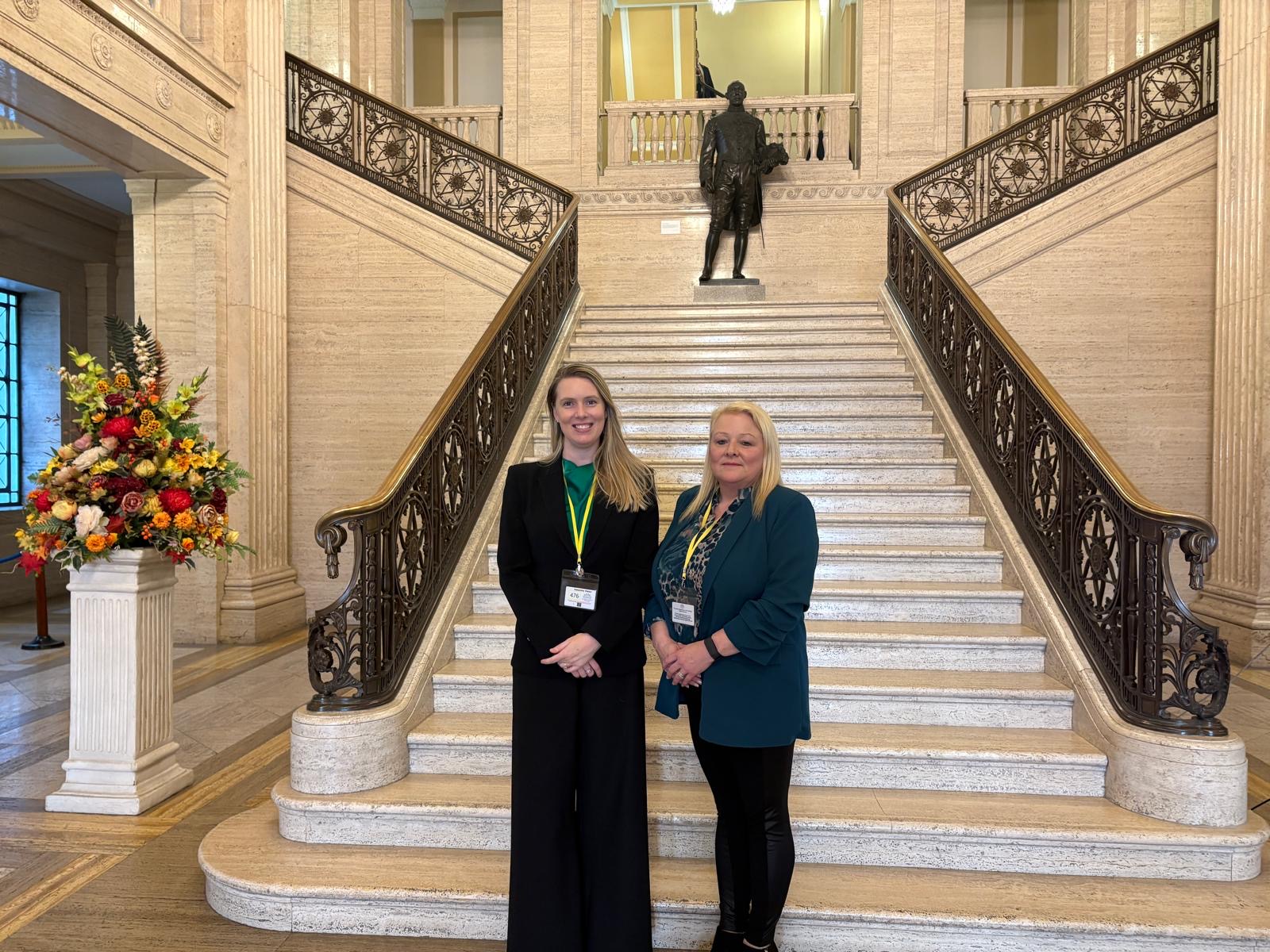
BELFAST, 10 November 2026 — Dr Georgia Richards, epidemiologist at King’s College London and founder of the Preventable Deaths Tracker, and Sarah Jane Campbell, Founder and Service Manager of The Well Suicide Prevention, came together yesterday at Stormont to give evidence to the All-Party Group (APG) on Suicide Prevention.
Together, they called for the establishment of a Preventable Deaths Tracker in Northern Ireland to ensure that lessons identified following suicides and other premature deaths are systematically collected, analysed, and translated into action.
The call comes amid continuing concerns about suicide in Northern Ireland, which recorded an age-standardised suicide mortality rate of 17.4 deaths per 100,000 population in 2024, compared with 12.7 in Scotland and 11.4 in England and Wales.
Despite these figures, Northern Ireland currently lacks a comprehensive national system for bringing together findings from coronial death investigations, identifying recurring risks and tracking whether recommendations to prevent future deaths are implemented.
Hundreds of deaths investigated, but lessons remain fragmented
In 2024, 18,050 deaths occurred in Northern Ireland, of which 5,393 — approximately one-third — were reported to coroners. The year saw only 67 inquests.
Although coronial death investigations can uncover important evidence about the circumstances surrounding deaths and coroners can write to an authority raising concerns, this information is not systematically published, collected, or analysed in Northern Ireland.
Researchers have demonstrated the value of using coronial data in Northern Ireland, previously analysing 1,667 suicides and identifying patterns in service use and circumstances preceding death.
However, much of the information generated through death investigations remains locked away, limiting opportunities for systematic national learning.
Turning lessons from deaths into prevention
The Preventable Deaths Tracker, established by Dr Richards in 2020, collects and analyses information from coroners in England and Wales and sheriffs in Scotland.
Its research has contributed to more than 25 peer-reviewed academic publications, policy reports and evidence used in parliamentary debates.
Extending this work to Northern Ireland could provide a UK-wide resource to identify recurring risks, improve transparency and monitor effective actions following preventable deaths.
Dr Georgia Richards, founder of the Preventable Deaths Tracker, said:
“Every coroner’s investigation is an opportunity to learn that could save another person’s life. Yet across Northern Ireland, important lessons are buried and inaccessible to the organisations or systems that could act on them.
“We have the expertise and technology to identify patterns, highlight recurring failures and monitor whether interventions lead to meaningful change. A Preventable Deaths Tracker for Northern Ireland would help turn information gathered after deaths into evidence that can prevent future tragedies.
“We must move beyond investigating deaths in isolation and towards a system that learns from them collectively.”
Sarah Jane Campbell, Founder and Service Manager of The Well Suicide Prevention in Kilkeel, said:
“Behind every suicide is a person, a family and a community whose lives are changed forever. Families deserve to know that when someone dies, every possible lesson is learned and that those lessons lead to meaningful action.
“Working on the frontline of suicide prevention, we see the importance of identifying risks early, connecting services and ensuring that people do not fall through the gaps.
“We need a system that brings these lessons together across Northern Ireland, so that families are heard, services can improve, and future lives can be saved.”
But this is not the first time Sarah Jane Campbell has highlighted this gap.
An opportunity to save lives
The Preventable Deaths Tracker for Northern Ireland would bring together coronial files that could be linked to other data systems such as GP and hospital records to identify patterns and learnings for public health and safety, including evidence to improve mental health services, addiction treatment, social care, housing, transport, education, justice, and regulators.
It could also support greater accountability by recording coroners’ concerns, organisational responses, and evidence of implementation.
Dr Richards and Ms Campbell highlighted that countries including Australia, New Zealand and Canada have established national coronial information systems that support research, public health surveillance and prevention.
They argued that Northern Ireland could build on existing research and coronial processes to develop a comparable approach tailored to its own legal and healthcare systems.
With HM Treasury valuing the prevention of a fatality at more than £2.6 million in 2023, effective prevention also has the potential to deliver substantial wider economic and societal benefits.
A call for action
Following yesterday’s evidence session at Stormont, Dr Richards and Mrs Campbell called for urgent, coordinated action to establish a Preventable Deaths Tracker in Northern Ireland, supported by legislative reform, cross-government leadership, and sustainable support.
Dr Richards noted that the coroner system in Northern Ireland operates principally under legislation that is 67 years old – the Coroners Act (Northern Ireland) 1959. She stated:
“Across the United Kingdom, Coroners’ Services are overlooked and the most neglected part of the justice system. No one wants to take responsibility for learning from deaths.”
“In the annual Judicial Statistics for Northern Ireland, coroners’ business is deemed “miscellaneous”. Instead, the Coroner’s Court should be recognised as a central pillar of the justice system, with learning from investigations as a shared priority across all ministerial departments, led from the very top.”
Sarah Jane Campbell added: “We have an opportunity to turn the learning from preventable deaths into something that makes a real difference for people across Northern Ireland.”
“That learning reaches across health, education, justice and beyond. With leadership across government, we can bring the evidence together, identify where people are being missed and use it to inform where funding and support will have the greatest impact.”
“There is expertise here, and there are approaches elsewhere that we can learn from. We need to be open to new ideas and willing to turn that knowledge into practical action.”
“For bereaved families, knowing that their experience can help protect another family matters. This is an opportunity to honour the people we have lost by acting on what their deaths can teach us.”
“We have the knowledge, the commitment and the opportunity. Now we need to work together to turn that learning into action — creating lasting change that saves lives.”
Their message to the All-Party Group was clear: This cannot be the sole efforts of two tenacious individuals; statutory backing is needed to ensure sustainability.
After 67 years, it’s time for transformation – a Preventable Deaths Tracker for Northern Ireland alongside modern legislation that prioritises bereaved families, transparency, and accountability to ensure lessons are learnt.